ServicesReverse Osmosis
Reverse Osmosis Systems in Bellaire
Our under-sink reverse osmosis installs add a second faucet at your kitchen sink, delivering much cleaner water for drinking, cooking and ice. The unit tucks tidily into the cabinet, the faucet finish is picked to match your fixtures, and we treat your countertop with care throughout.
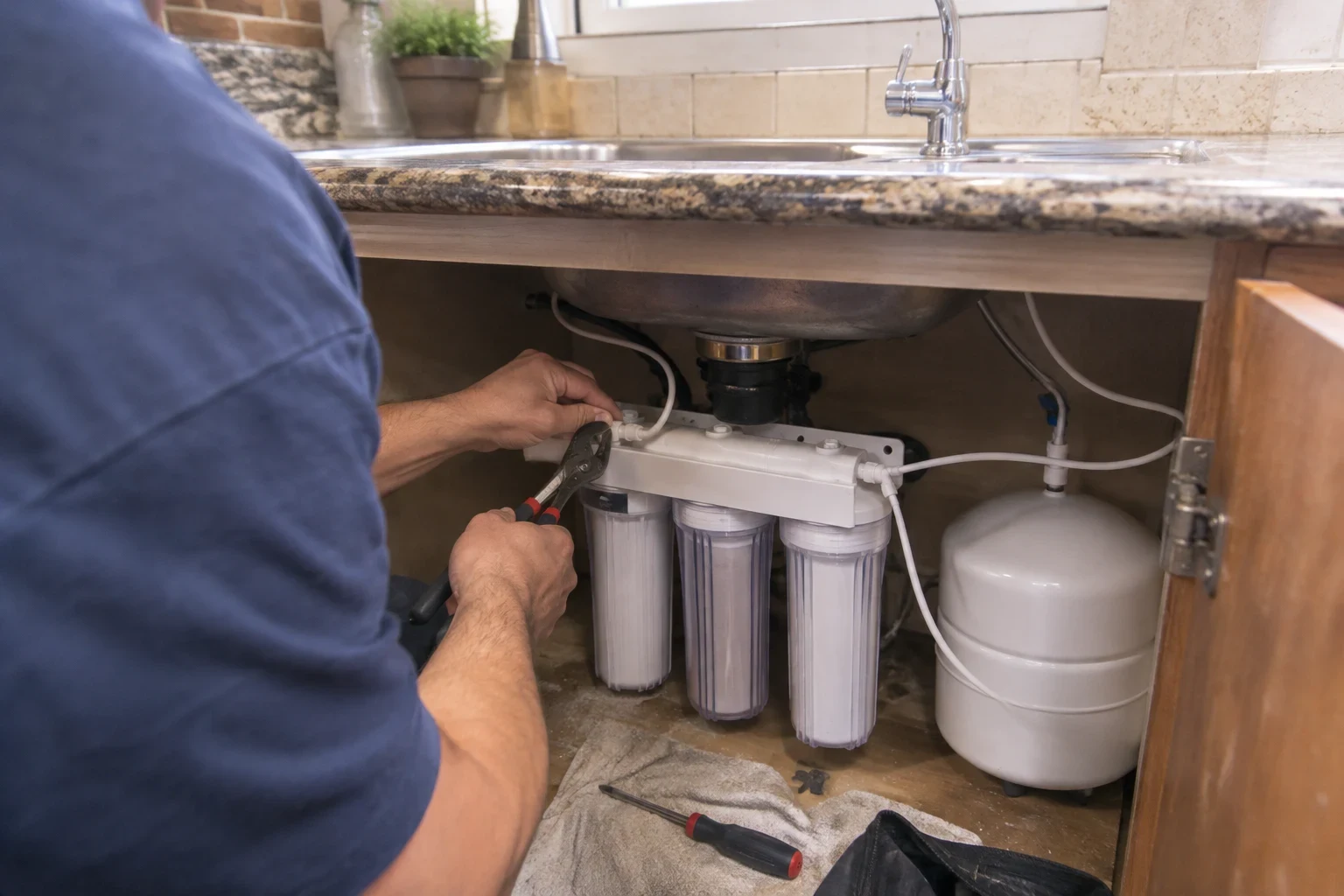
Clean water where you drink it
A reverse osmosis system forces water across a tightly woven membrane that rejects the large majority of dissolved solids. That includes lead, nitrates, fluoride and the disinfectant flavor a lot of people pick up in municipal water. Because it serves a single faucet, it is an efficient way to treat drinking and cooking water without running every shower and load of laundry through it.
RO is a good choice when you are tired of hauling bottled water, when you wonder about older pipes between the meter and your sink, or when a water test turns up something you would rather keep out of your glass. Some city water around Houston is disinfected with chloramine, and that needs the correct carbon stage in front of the membrane. We configure each system around the water coming into your home.
For softer water or treatment at every tap, see our Whole-Home Filtration and Water Softeners pages. An RO unit frequently runs alongside either one.
What comes with your RO installation
Pre-filtration set to your water
A sediment cartridge and a carbon cartridge sit ahead of the membrane to protect it. If your supply carries chloramine, we use catalytic carbon, because ordinary carbon struggles with it and the membrane then wears out sooner.
Membrane and water storage
Depending on your cabinet and how much water your family pulls at one time, we fit a compact pressure tank or a tankless unit with a small built-in pump.
A faucet chosen for your sink
We help you pick a finish that looks right next to your main faucet. On granite or quartz we drill slowly with a proper stone bit and keep the surface covered while we work.
Tidy drain and supply work
The drain connection uses a correct saddle fitting, plus an air gap where your setup calls for it, so waste water cannot flow back. Tubing is run cleanly so you keep the use of the cabinet.
Remineralizing and fridge options
A remineralizing cartridge can restore a touch of calcium and magnesium for fuller taste. We can also tie the system into your refrigerator, so the ice maker and water dispenser draw the same treated water.
When reverse osmosis is worth a look
Bottled water is a weekly purchase
If cases of water show up on every shopping list, a dedicated faucet saves the trips and the lifting, and the stack of plastic in the garage goes away.
You can taste the chlorine
A swimming-pool note in your water, coffee or tea comes from the disinfectant. It is not a safety problem, but the carbon stage and membrane remove it from what you drink.
The plumbing has some age on it
Houses from before about 1986 may have copper pipe joined with lead solder, or older galvanized lines. RO ranks among the most effective methods for taking lead out at the faucet.
Cloudy ice and filmy glasses
A white haze on glassware and murky ice cubes point to high dissolved solids. Water from an RO tap leaves very little residue.
Your test results raised a flag
When a lab report or home kit shows nitrates, arsenic, fluoride or high total dissolved solids, RO reduces most of them. Our Water Testing page describes how we check before recommending anything.
From first call to first glass
- 1
Start with a phone call
Let us know what you notice in your water and how your family uses it day to day. We will ask about the age of the house, your sink and the cabinet underneath so we show up with the right parts.
- 2
A look at your water and cabinet
We check water pressure, since RO performs best above roughly 40 psi, and measure total dissolved solids. Then we review the cabinet, the drain and your counter material and lay out the options in a written estimate.
- 3
The installation visit
A typical install takes a few hours. We cover the floor and counter, mount the unit, drill a hole or reuse the sprayer opening for the faucet, connect drain and supply, and flush the new cartridges before anyone drinks from it.
- 4
Handover and ongoing care
Before we leave, we point out the shutoff valve, explain filter changes and describe the normal sounds of the tank refilling. We provide full services after the sale, so the same crew that installed your system looks after its filters and adjustments.
What moves the price of an RO system
Two things set the number: the equipment you pick and how much your kitchen has to be adapted to take it. Installation is free, so most of the estimate is hardware and any add-ons. We put every figure on paper before a work date is set.
- Storage tank versus tankless
- A tankless unit with its own pump costs more at the start, but it frees up cabinet room and makes water faster. A tank system has fewer parts and serves most households well.
- Pressure at your sink
- When pressure runs low, the membrane produces slowly and rinses more water to the drain. Adding a booster pump solves that, at the cost of one more component.
- The faucet and the countertop
- Faucet finishes range widely in price. A stone counter with no open hole needs a slower, more careful cut than laminate or a spare sprayer opening.
- Extra stages and lines
- Catalytic carbon for chloramine, a remineralizing cartridge and a refrigerator line are each a separate part. We suggest only the ones your water and routine actually need.
Common questions about reverse osmosis
Something not covered here? (713) 766-4767
How much water goes down the drain with RO?
Every reverse osmosis unit sends some water away to keep the membrane clean. Older models could waste four or more gallons for each gallon they made. Newer systems on decent pressure do much better, and a permeate pump or a tankless design narrows the ratio further. We will go over the numbers for the unit we recommend.
Will RO take out minerals I would rather keep?
Yes. The membrane removes most dissolved minerals along with the things you want gone, and some people notice a flatter taste. Most of the minerals your body uses come from food, not water. If you want a rounder flavor, we can add a stage that returns a little calcium and magnesium.
My sink cabinet already holds a disposal. Can an RO unit still fit?
Usually, yes. Tankless units are narrow, and a storage tank can sit at the side of the cabinet or in the cabinet next door. We measure the space before we recommend anything, so the system leaves the disposal and any pull-out trash bin free to work.
How often are filter changes needed?
Sediment and carbon pre-filters typically last six to twelve months. The membrane often goes two to three years, depending on your water and how much you draw. We give you a schedule for your exact system and can take care of the changes for you.
Should I add whole-home filtration too?
Not always. RO treats the water you drink and cook with at one faucet. If chlorine smell in the shower bothers you, or you want treated water at every tap, our Whole-Home Filtration service covers that, and it works well alongside RO.
Ready for a cleaner glass of water
Tell us about your sink, the cabinet below it and what bothers you about the water now. We will suggest a system sized for your household and explain each part before any work is scheduled.